
Data Access Lodi et al
Decoding tumor heterogeneity: A spatially informed pan-cancer analysis of the tumor microenvironment
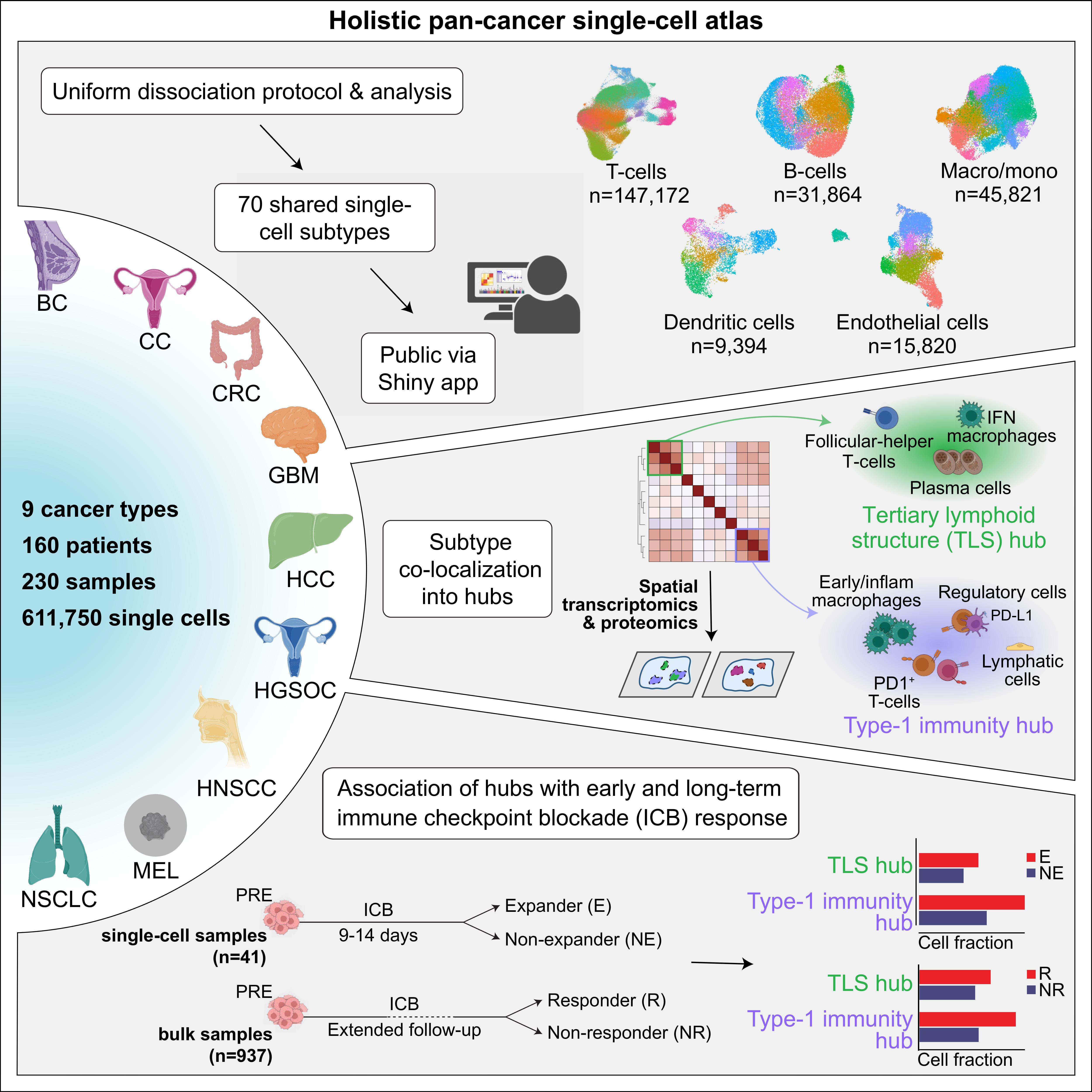
Pan-cancer single-cell atlases explore the heterogeneity of cell types residing within the tumor-microenvironment (TME). So far, atlases focused on individual cell types, failing to capture the full complexity of the TME. Here, we present a single-cell atlas that simultaneously considers heterogeneity in 5 cell types, collected from 230 treatment-naïve samples across 9 cancer types. We identify 70 pan-cancer single-cell subtypes, investigate their patterns of co-occurrence and show an enrichment of specific subtypes in certain TMEs, e.g. immune-reactive versus -suppressive TME. We observe two TME hubs of strongly co-occurring subtypes: one hub resembling tertiary lymphoid structures (TLS), another consisting of immune-reactive PD1+/PD-L1+ immune-regulatory T- and B-cells, dendritic cells and inflammatory macrophages. Subtypes belonging to each hub are spatially co-localized, while their abundance associates with early and long-term checkpoint immunotherapy response. We publicly share our atlas using a Shiny app, allowing others to explore TME heterogeneity in different biological contexts.
Decoding tumor heterogeneity: A spatially informed pan-cancer analysis of the tumor microenvironment. Lodi et al. – 2025 – Cell Reports Medicine
Data Availability
Dataset accession numbers for unprocessed, raw sequencing data are listed in Table S1 of the manuscript. Specifically, these raw sequencing reads have been deposited under restricted access in the European Genome-phenome Archive (EGA), in compliance with local data protection regulations. Requests for accessing raw sequencing reads will be reviewed by the VIB data access committee according to the European GDPR law, and accessibility will be granted depending on whether the proposed analyses are covered by the informed consent of the patient and after signing a data transfer agreement.
Unprocessed ‘read count data’ along with the patient metadata can be freely accessed via this website. This allows the data to be explored at individual patient level, at cell type or at cancer type-specific level. For clarity, these are the unprocessed read count data that already underwent QC analysis as described in the Methods, but were not further processed. The metadata that we provide include key information such as SampleID, PatientID, cancer type, biopsy site (primary tumor, metastasis, normal tissue, tumor-draining lymph node), sequencing technology (3’ or 5’), nCount, nFeature, percent.mt, and detailed cell annotations (Majorcelltype_annotation, Intermediatecelltype_annotation, and Minorcelltype_annotation, as outlined in the provided code). Additionally, T-cell reactivity scores are included to facilitate dataset exploration by others.
Shiny App
We also allow researchers to explore our ‘processed read count’ data per cell type (i.e., after normalisation, batch correction and integration) via our Shiny app below.